
Supreme Court on Government Action and Constitutional Rights: What the Recent Order Means
The Supreme Court of India regularly examines whether government authorities are carrying out their duties properly and whether the rights of citizens are being protected. A recent order in S. Rajaseekaran v. Union of India has again brought attention to government responsibility, road safety and the enforcement of traffic rules.
The case is related to road safety and electronic enforcement of traffic violations. During the proceedings on 28 September 2026, the Supreme Court discussed the large number of unpaid electronic traffic challans across the country and considered different ways to improve the recovery of these fines. The order was uploaded on the Supreme Court website on 1 October 2026.
The discussion is important because issuing a traffic challan is only one part of enforcement. If fines remain unpaid for a long time, authorities may find it difficult to ensure that traffic rules are properly followed.
Why Did the Supreme Court Consider the Issue?
Electronic challans have become an important part of traffic enforcement in India. Cameras and other electronic systems can identify traffic violations and generate challans without requiring a police officer to stop every vehicle.
However, the Supreme Court was informed that a large amount of money in e-challan fines remains unpaid.
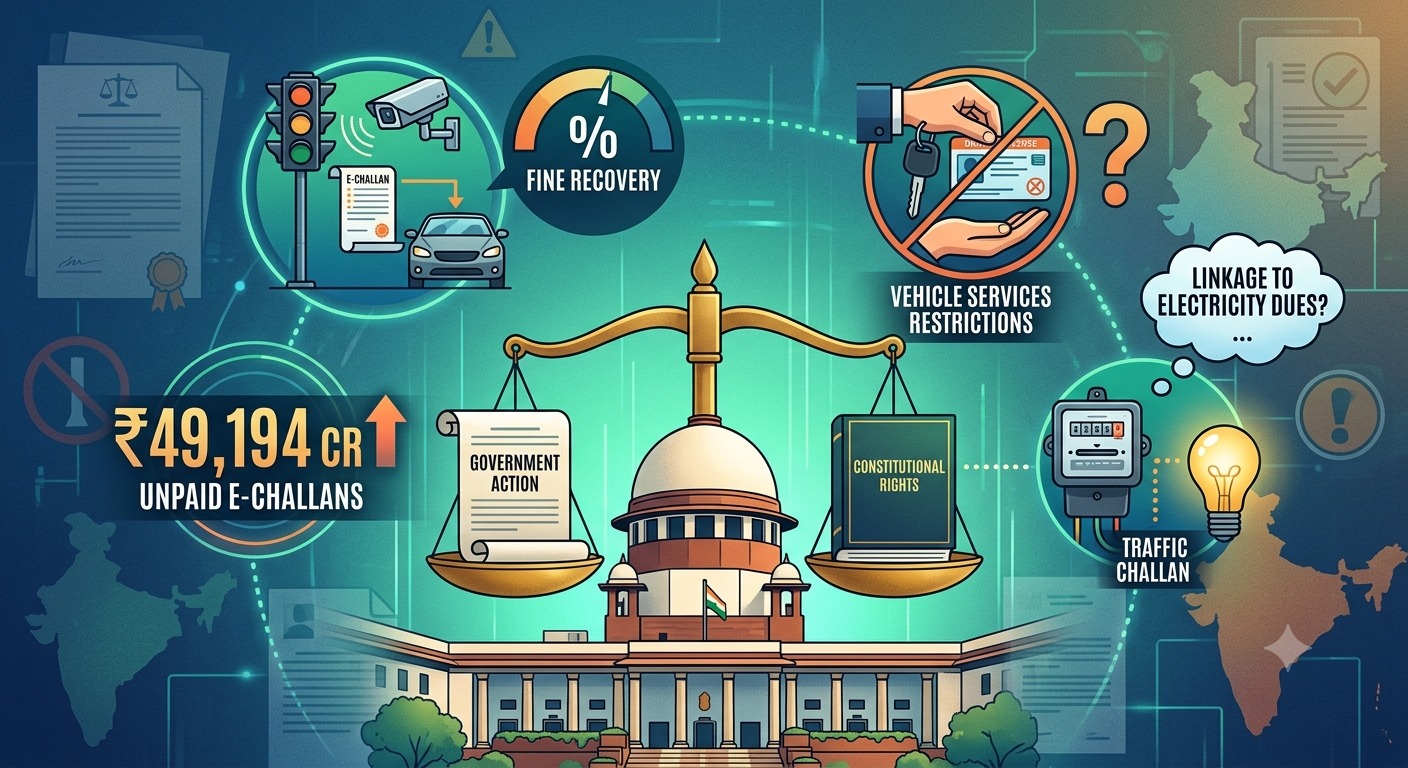
Reports on the 28 September proceedings said that the Court was informed about approximately ₹49,194 crore in e-challans issued across States and Union Territories, with around ₹26,175 crore recovered. This left a substantial amount still outstanding.
The Court therefore discussed how authorities could make enforcement more effective.
The issue was not simply about collecting money. It was also connected with making traffic enforcement meaningful. If a person repeatedly violates traffic rules but does not pay the resulting penalties, the effectiveness of the enforcement system can be reduced.
What Did the Supreme Court Discuss?
During the hearing, the Supreme Court discussed several possible measures for dealing with unpaid traffic challans.
These included restrictions relating to vehicle registration, transfer of ownership, fitness certificates and Pollution Under Control certificates. The Court also discussed measures concerning driving licence renewals in cases involving repeated violations.
Another suggestion discussed during the hearing was linking unpaid traffic challans with electricity dues.
This attracted attention because it would connect an unpaid traffic penalty with another important public service.
However, it is important to understand the legal position correctly. These were measures discussed or suggested during the proceedings. They should not automatically be described as a nationwide rule that has already come into force.
What Does This Mean for Vehicle Owners?
For vehicle owners, the proceedings highlight the importance of checking and clearing pending traffic challans.
An unpaid challan can remain on the relevant government system and may create problems depending on the rules and enforcement measures applicable in the particular State or Union Territory.
The Supreme Court’s discussion shows that authorities are looking for stronger ways to ensure compliance with traffic laws.
Vehicle owners should therefore not ignore electronic challans simply because there was no physical notice from a traffic officer.
If a person believes that an e-challan has been issued incorrectly, the appropriate legal or administrative process should be followed to challenge it rather than simply ignoring it.
Government Responsibility and Constitutional Rights
The issue also raises a broader question about government action.
Government authorities have the responsibility to enforce laws, but enforcement must also follow the law.
A traffic enforcement system should therefore be based on clear legal provisions and proper procedures.
Citizens also have legal rights when government action affects them.
This is an important part of the constitutional system in India. Government authorities cannot exercise their powers without legal authority. At the same time, citizens are expected to follow valid laws and regulations.
The relationship between government power and individual rights is therefore based on a balance between enforcement and legal protection.
What Is the Role of Article 21?
Article 21 of the Constitution protects the right to life and personal liberty.
Road safety has a direct connection with the protection of life because traffic accidents can cause serious injuries and deaths.
The Supreme Court has been dealing with road-safety issues in the S. Rajaseekaran proceedings for several years. The case has involved questions about the implementation of road-safety measures and the responsibilities of different authorities.
The recent proceedings continue this wider focus on effective road-safety enforcement.
The objective is not only to issue more challans. Authorities also need an enforcement system that works properly and encourages compliance with traffic laws.
Can Government Authorities Take Any Action They Want?
No.
Government authorities must act within the powers given to them by the Constitution and the law.
When a government department takes action against a person, there should be a legal basis for that action.
Depending on the circumstances, a person may be able to challenge government action if it is alleged to be unlawful, arbitrary or beyond the authority’s legal powers.
The availability of a legal remedy depends on the facts and the applicable law.
This principle is an important part of judicial review.
What Is Judicial Review?
Judicial review allows courts to examine government action.
For example, a court may consider whether a government authority had the legal power to take a particular decision or whether the authority followed the required procedure.
Judicial review does not mean that courts take over the work of government departments.
Instead, it allows courts to ensure that public authorities remain within the limits of the Constitution and the law.
This is particularly important when government decisions affect the rights of individuals.
Why Is Effective Traffic Enforcement Important?
Traffic rules are designed to improve road safety and reduce dangerous driving.
Rules relating to speeding, red lights, helmets, seat belts and other traffic requirements are intended to encourage safer behaviour on roads.
If violations are detected but penalties are never recovered, the enforcement system may lose some of its effectiveness.
This is why the Supreme Court has focused on the recovery of unpaid e-challans.
The Court’s discussion also shows the increasing role of technology in law enforcement. Electronic challans, vehicle databases and digital records can help authorities identify violations and track pending penalties.
At the same time, these systems must be used according to law and with appropriate safeguards.
What Happens If a Person Disagrees With an E-Challan?
A person who believes that a traffic challan has been wrongly issued should use the available process for challenging it.
Simply ignoring the challan may not resolve the issue.
The appropriate procedure can depend on the nature of the challan and the jurisdiction involved.
Vehicle owners should check the official government traffic or transport system for the status of the challan and the available options.
Where there is a serious legal dispute, appropriate legal advice may also be considered.
The Importance of Due Process
Strong enforcement does not remove the need for fair legal procedure.
When technology is used to issue traffic challans, there should be a proper system through which a person can know about the alleged violation and challenge it where appropriate.
This becomes particularly important when further action may be taken because of an unpaid penalty.
A fair system should therefore combine effective enforcement with an opportunity to resolve genuine mistakes or disputes.
What Does the Recent Order Tell Us About Government Action?
The recent proceedings provide a useful example of how the Supreme Court examines the implementation of laws and government responsibilities.
The Court did not simply look at whether challans were being issued. It also considered whether the enforcement system was actually resulting in recovery of penalties.
This reflects a broader concern with effective administration.
A law may exist on paper, but its purpose can be weakened if it is not properly implemented.
Government authorities therefore have an important responsibility to ensure that laws are enforced in a practical and lawful manner.
A Broader Constitutional Perspective
The case also shows that constitutional law can be connected with ordinary issues faced by citizens.
Road safety may initially appear to be only a traffic-management issue. However, it is also connected with the protection of life and public safety.
At the same time, enforcement measures affect individual citizens and therefore need to operate within the legal framework.
This is where constitutional principles become important.
The government has the authority to enforce laws, but citizens also have rights against unlawful or excessive government action.
Conclusion
The Supreme Court’s recent proceedings in S. Rajaseekaran v. Union of India highlight the need for effective traffic enforcement and responsible action by government authorities.
The Court discussed the problem of unpaid e-challans and considered different ways to improve recovery, including possible restrictions connected with vehicle and licence-related services. The Court also discussed the possibility of linking unpaid challans with electricity dues. These discussions should not be treated as a general nationwide rule unless and until the relevant legal directions are formally implemented.
The proceedings are also important from a broader constitutional perspective. Government authorities have a duty to enforce laws, but they must exercise their powers within the Constitution and applicable legislation.
For citizens, the key point is simple: traffic rules should be followed, pending challans should not be ignored, and genuine disputes should be addressed through the proper legal process.
The case also demonstrates how the Supreme Court continues to examine whether public authorities are effectively implementing measures connected with road safety and public welfare.
Frequently Asked Questions
1. What is the recent Supreme Court matter about?
The matter concerns road safety, electronic enforcement of traffic violations and the recovery of unpaid e-challans.
2. Did the Supreme Court order that unpaid challans must be added to electricity bills?
The Court discussed and suggested this as a possible method of recovery. It should not be treated as a nationwide rule automatically applicable to everyone.
3. Can unpaid challans affect vehicle-related services?
The Supreme Court discussed possible restrictions involving registration, ownership transfer, fitness and PUC-related services. The actual implementation depends on the applicable directions and legal framework.
4. Can a person challenge an incorrect e-challan?
Yes. If a person believes that an e-challan was wrongly issued, the available official process for challenging or contesting it can be used.
5. What is Article 21 of the Constitution?
Article 21 protects the right to life and personal liberty. Road safety can have a direct connection with the protection of life and public safety.
6. What is judicial review?
Judicial review is the power of courts to examine whether government action is lawful and consistent with the Constitution.
7. Why is this Supreme Court proceeding important?
It highlights the need for effective traffic enforcement while also showing that government authorities must exercise their powers within the limits of the law.